- Shrikrupa Soc Rees, Khalapur, Panvel-II Raigad Raigarh MH 410206 IN
- gethonoraryphd@gmail.com
Phone Number
+91-8655502244
+91-7893528657
Email Address
gethonoraryphd@gmail.com
+91-8655502244
+91-7893528657
gethonoraryphd@gmail.com


 by PhD Duniya
Choosing the right course after school or graduation can shape your entire career path, and a DBM program is one option that continues to attract students who want a practical, industry-focused business education. DBM, or Diploma in Business Management, is designed to equip students with core management skills without requiring the long time commitment of a traditional degree.
If you're wondering what comes after you finish this diploma, you're not alone. Many students choose a DBM program specifically because of the wide range of career opportunities it opens up, from entry-level management roles to specialized positions in finance, marketing, and operations. In this article, we'll walk through the top career paths available after completing a DBM program, the skills that make you job-ready, and how to make the most of this qualification in a competitive job market.
What Is a DBM Program?
A DBM program, or Diploma in Business Management, is a short-term professional course that covers foundational business subjects such as management principles, marketing, human resources, finance, and organizational behavior. It's typically pursued by:
The course usually spans anywhere from six months to two years, depending on the institute, and blends theoretical knowledge with practical case studies and projects.

Why Career Opportunities After a DBM Program Are Growing
Businesses today need employees who understand core management functions and can apply them quickly. A DBM program is built around this need, which is why graduates are increasingly sought after in the following ways:
Top Career Opportunities After a DBM Program
Business development roles are among the most common starting points for DBM graduates. In this role, you'll identify new business opportunities, build client relationships, and support company growth strategies.
Key skills used: communication, negotiation, market research
HR is a natural fit for those who studied organizational behavior and personnel management as part of their DBM program. Entry-level HR roles include recruitment, employee engagement, and training coordination.
Key skills used: interpersonal skills, conflict resolution, HR software tools
If your DBM program included marketing modules, you're well positioned for roles in digital marketing, brand management, or market research. Many companies hire diploma holders for junior marketing positions and provide on-the-job training.
Key skills used: campaign planning, social media marketing, consumer behavior analysis
Operations roles focus on the day-to-day running of a business, supply chain coordination, process improvement, and logistics. This path suits graduates who enjoy structured, process-driven work.
Key skills used: process management, problem-solving, data analysis
Sales remains one of the highest-demand career paths for business diploma holders. With strong performance, sales executives can move up quickly into managerial roles.
Key skills used: persuasion, relationship building, target achievement
For those who focused on finance electives, entry-level analyst roles in banking, insurance, or corporate finance departments are a strong option.
Key skills used: financial reporting, basic accounting, analytical thinking
This role involves managing client accounts, resolving service issues, and maintaining long-term customer satisfaction; it's a good fit for graduates with strong communication skills.
Key skills used: client servicing, CRM tools, problem resolution
Retail chains often hire DBM graduates into management trainee programs, offering a fast track to store or regional management positions.
Key skills used: inventory management, team supervision, customer service
Many DBM Program graduates use their business fundamentals to start their own ventures, particularly in retail, services, or e-commerce, where the diploma's practical grounding in management basics is directly applicable.
A significant number of graduates use the DBM Program as a stepping stone toward an MBA or specialized postgraduate certifications in areas like digital marketing, HR analytics, or supply chain management.
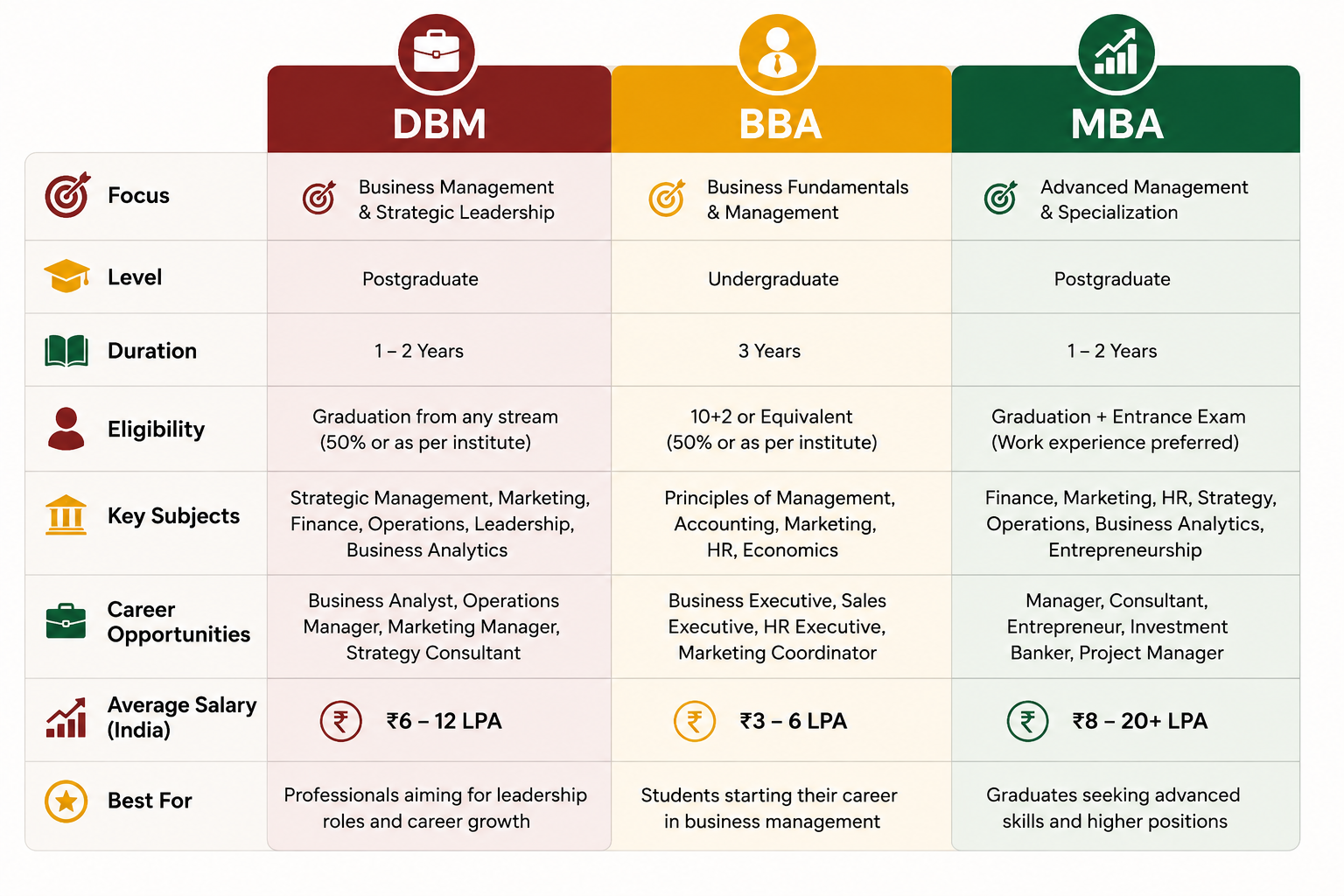
Comparison: DBM Program vs Other Business Qualifications
Feature | DBM Program | BBA | MBA |
Duration | 6 months–2 years | 3 years | 1–2 years (after graduation) |
Cost | Low | Moderate | High |
Entry requirement | 10+2 or graduate | 10+2 | Graduate degree |
Career level | Entry-level | Entry to mid-level | Mid to senior-level |
Best for | Quick job entry, upskilling | Full academic foundation | Leadership and specialization |
Skills Employers Look For in DBM Graduates
Regardless of the specific role, employers generally value the following skills, which a well-rounded DBM program helps develop:
Tips to Maximize Career Opportunities After a DBM Program
Conclusion
A DBM program offers a practical, accessible route into the business world, with career opportunities spanning marketing, HR, operations, sales, finance, and beyond. Whether you choose to enter the workforce immediately or use the diploma as a stepping stone toward an MBA, the skills you gain are versatile and in demand across industries.
If you're currently exploring your options after a DBM program, focus on building practical experience through internships, targeted certifications, and networking. These steps will help you stand out in a competitive job market and open doors to long-term career growth.
Frequently Asked Questions (FAQs)
1. What is a DBM Program?
A DBM program (Diploma in Business Management) is a short-term course covering core business subjects like management, marketing, HR, and finance, designed to prepare students for entry-level business roles.
2. How long does a DBM program take to complete?
Most DBM programs range from six months to two years, depending on the institute and mode of study (full-time, part-time, or online).
3. What jobs can I get after a DBM program?
Common roles include business development executive, HR executive, marketing executive, operations executive, sales executive, and customer relationship executive.
4. Is a DBM program better than a BBA?
It depends on your goals. A DBM program is shorter and more practical, ideal for quick job entry, while a BBA offers a broader academic foundation over three years.
5. Can I pursue an MBA after a DBM program?
Yes, many students use a DBM program as a foundation before pursuing an MBA, especially if the DBM was combined with a bachelor's degree.